


What is PAT testing, and is it a legal requirement?
The law behind all this is the Electricity at Work Regulations 1989, which say that electrical equipment that could cause danger has to be maintained so it doesn't. What they don't say is how you do that, or how often. When people ask the Health and Safety Executive whether PAT testing is a legal requirement, HSE's own answer is a plain no. It's one of the ways an employer can show they've met the duty to maintain their equipment, alongside the checks staff make when they use something and visual inspections by someone trained to do them.
The industry guidance has moved on too. The Institution of Engineering and Technology (IET) Code of Practice for In-service Inspection and Testing of Electrical Equipment reached its fifth edition in 2020, and it dropped the fixed table of test frequencies that earlier editions carried, asking each workplace to do its own risk assessment instead. It's also moved away from the phrase "portable appliance testing", because what really matters is how an item is built and where it's used, not whether it's easy to carry about.
How often does PAT testing need doing?
It comes down to two things: how the item is built, and how hard a life it has. HSE's leaflet for low-risk workplaces such as offices, shops, some parts of hotels and residential care homes gives suggested starting points, and honestly, they're a lot more relaxed than most people expect:
- Earthed (Class I) equipment such as kettles, irons and some floor cleaners: user checks before use, a formal visual inspection every six months to a year, and a combined inspection and test every one to two years.
- Hand-held double insulated (Class II) equipment: user checks, and a formal visual inspection on the same six-to-twelve-month cycle, but no test.
- Desktop computers, screens, photocopiers and fax machines: a visual inspection every two to four years, with a test only if the item isn't double insulated, and then up to five years apart.
- Battery-operated equipment under 40 volts: nothing formal at all.
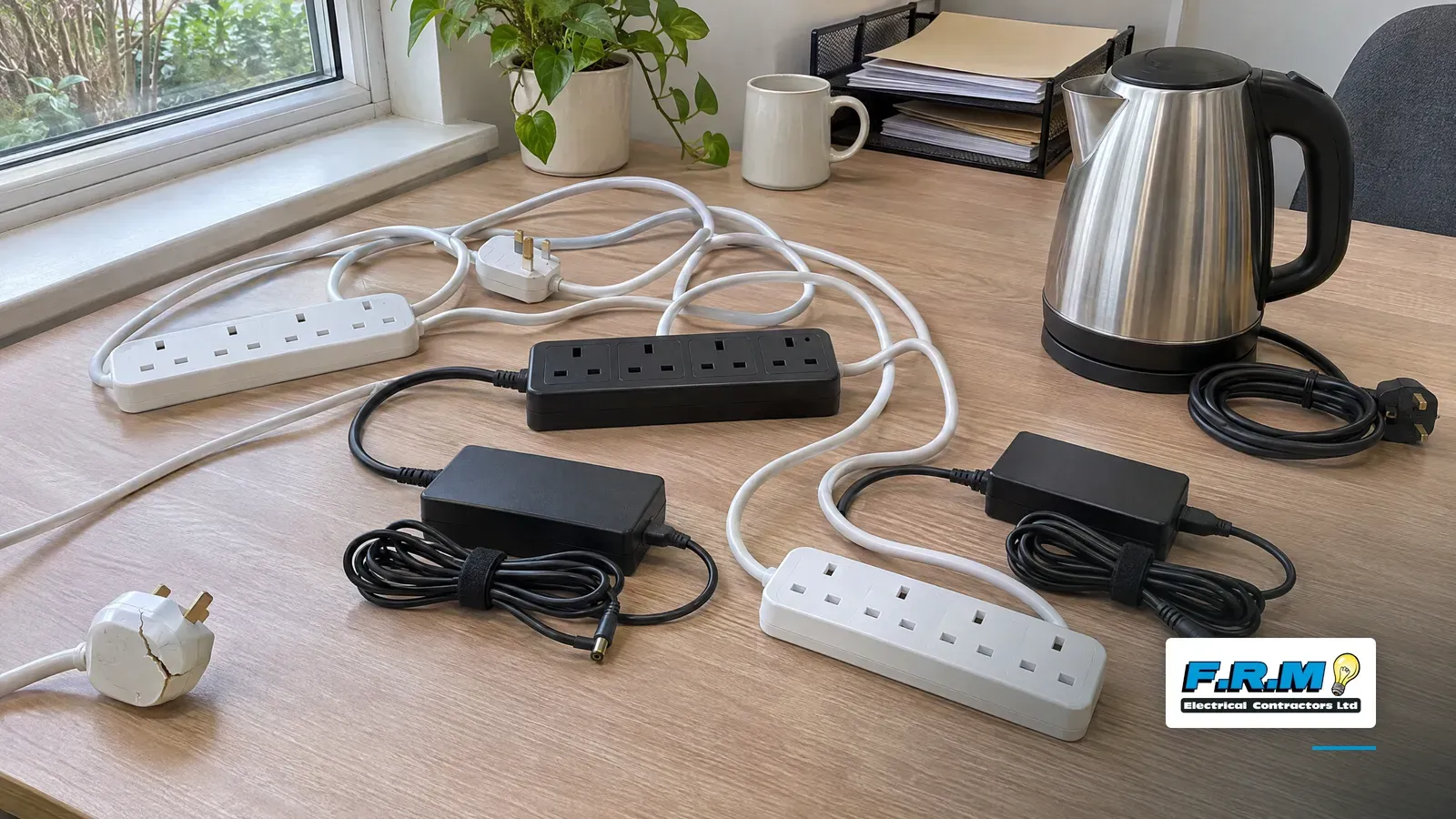
- Extension leads, cables and battery chargers: a formal visual check somewhere between six months and four years apart, and a combined test every one to five years, depending on what they supply.
Treat those as a place to start rather than rules. If the first round turns up very few faults, you can stretch the interval, and if it turns up plenty, you should shorten it. Where items are tested as a batch, the shortest interval in the group applies to all of them. A workshop, a commercial kitchen or a building site is far harder on equipment than an office, so those places need shorter intervals.
There's one detail a lot of people don't know. HSE says the person doing the testing shouldn't be the one who decides when the next test is due. That decision belongs to the business, based on its own risk assessment, so a good tester will hand over the results and any patterns they show, and leave the date to you. If someone's telling you everything has to be done every twelve months without looking at what you've got, it's worth asking why.
What happens on the day
Every item starts with a formal visual inspection, and you'd be surprised how much that catches on its own: a lead that's been cut or crushed, a cracked plug, scorch marks, a cable held together with tape, or coloured wires showing where the cord grip has let go. Where the plug can be opened, we look inside it too, to check the fuse is the right rating and is a proper fuse, the terminals are tight and the right wires are on the right pins. On a moulded plug, only the fuse can be checked.
Earthed equipment is then tested with a proper instrument. That covers the continuity of the earth path from the plug to the metal casing, the insulation between the live parts and anything you can touch, and, for extension leads and detachable cables, polarity. Double insulated equipment, the kind marked with a square inside a square, relies on its casing rather than an earth, and HSE's guidance is that it needs a careful visual inspection rather than a test. If that symbol is missing, the item is treated as earthed and tested. Each result goes on the record against the item, passes are labelled, and anything that fails is labelled as a failure and taken out of use there and then.
PAT testing for landlords, licensed rentals and social housing
If you're a private landlord, there's no specific law that says you have to PAT test. The electrical safety regulations for private rented homes cover the fixed installation, which is what an Electrical Installation Condition Report (EICR) inspects, and our Rotherham EICR page deals with that side of things. The appliances you supply still have to be safe, though, and testing them at the same visit is a simple way to show that they are.
Licensed rentals are a different matter. Every property licence, whether it's for a shared house (an HMO, or house in multiple occupation) or a home in one of Rotherham's selective licensing areas, carries a mandatory condition under the Housing Act 2004. Whoever holds the licence must make sure any electrical appliances and furniture supplied with the home are kept safe, and give the council a declaration of their safety when asked. A PAT record is the most straightforward evidence you can have to back up that declaration.
Social landlords now have a further duty on top. Equipment they provide, such as cookers and fridges, has to be checked by someone qualified, with no more than five years between checks. Our landlord electrical safety guide explains how that came in, and the landlords page has the rest of what we do for letting agents and people with a portfolio.
Offices, shops, workshops and sites
Testing means unplugging every item in turn, and that's the part businesses worry about, so we plan it around you. Offices are often easiest first thing, in the evening or at a weekend, and we'll work through the IT desk by desk so nobody loses what they're working on. Shops tend to suit the time before opening, and workshops the gap between shifts. Anything that can't be switched off without warning, like servers, refrigeration or medical and security equipment, gets agreed with you beforehand rather than discovered on the day.
For a lot of businesses, PAT sits alongside periodic testing of the fixed wiring, and doing both together saves you a second round of disruption. Our main test and inspection page covers fixed-wire testing and the other inspections we carry out, and the commercial and industrial page is where you'll find our other work for businesses.
Why have PAT testing done by an electrician?
Because the job doesn't stop at a pass or a fail. A plug with the wrong fuse, a lead with a damaged sheath near the plug, or a rewireable plug with loose terminals can often be put right on the spot and retested, instead of ending up in a pile of failed kit in the corner. An electrician also looks past the appliance itself. A socket that's scorched or loose, an extension lead plugged into another extension lead, or a heater running off a multi-way adaptor is a problem with how the building is being used, and we'll tell you about it rather than walk past it.
At the end you get a record of every item, its result and what was done about anything that failed. We're NICEIC-approved electrical contractors working in Rotherham and right across South Yorkshire from Wath upon Dearne, and the full list of towns is on our areas page.