
What not being MCS certified means for you
MCS is the certification scheme for small-scale renewable installers. Smart Export Guarantee tariffs ask for an MCS certificate, so plan on the surplus an FRM system sends out to the grid earning you nothing. Some funders and insurers ask for the same certificate, and so may a buyer's solicitor if you sell.
What does not change is the installation itself. The panels generate exactly as they would for anyone else, the wiring is designed and certified to BS 7671, and the system is registered with Northern Powergrid, the network operator for Rotherham.
So the question is whether you can use what the roof produces. A household suits us if somebody is in during the day, or if there is something to soak up the midday output, which a later section covers. If the house is empty until six, you have no storage, and you were counting on export income, an MCS installer is the better choice, and we would sooner tell you so than take the job.
Solar panel installation in Rotherham, roof by roof
The borough's housing decides more about a solar job than the brand of panel does.
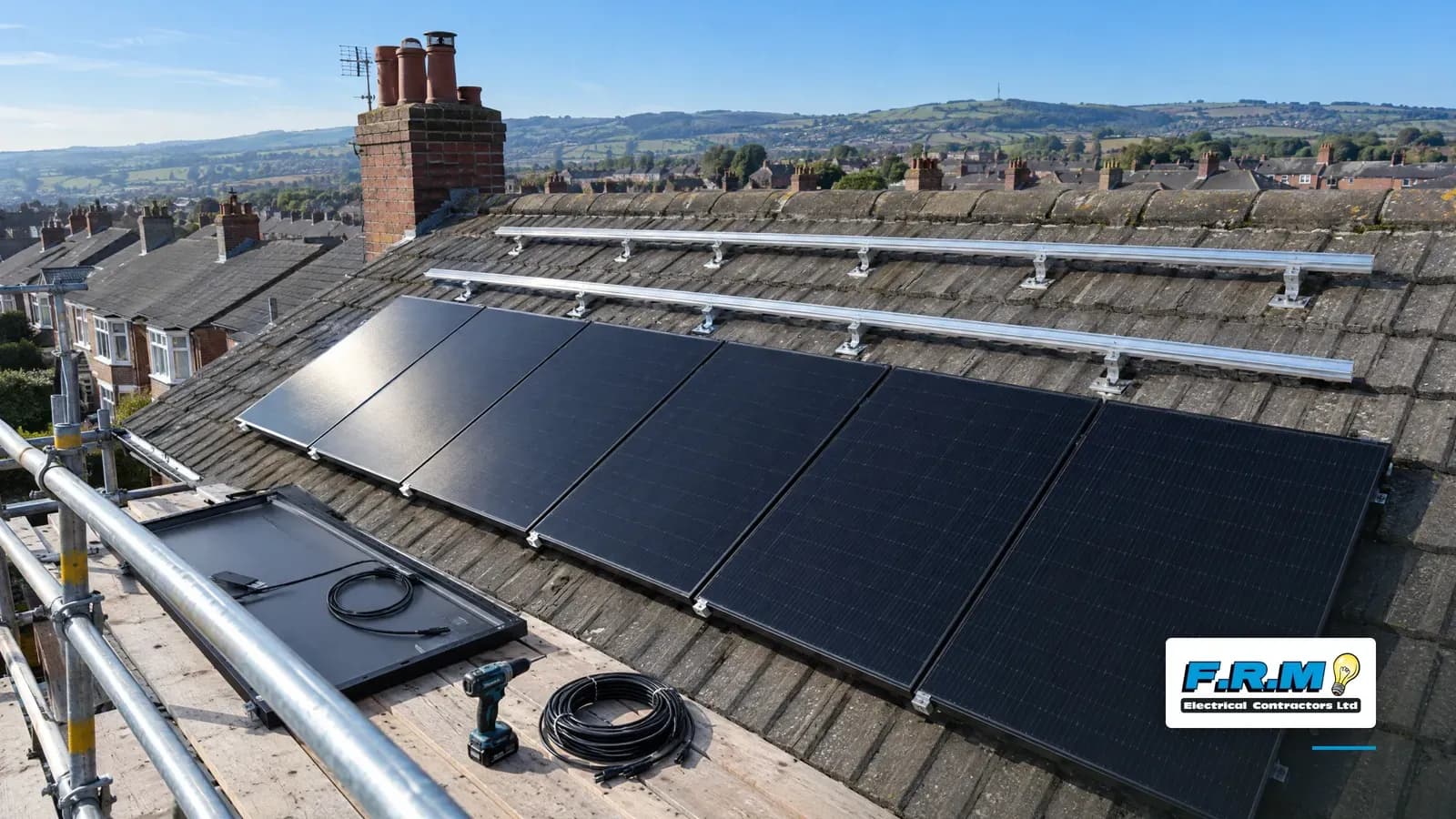
Terraces. On the older streets around Masbrough and Eastwood the main roof is narrow and the chimney stacks, yours and next door's, throw shadows that travel across it through the day. With only a few panels up there, one in shade should not be allowed to hold the others back, so panel-level optimisers or microinverters are usually worth their cost here.
Estate semis. Where the roof is hipped, there are three smaller faces to work with instead of one large one. An array split across two of them is wired to separate inputs on the inverter, because panels facing different ways should not share a string.
Period houses. Towards Moorgate and Broom the roofs are bigger, but they are often slate and often old. Slate takes different fixings from concrete tile, and an ageing roof should be looked at by a roofer before anyone drills into it. Moorgate is also a conservation area, which brings in the planning points below.
Newer estates. At Waverley and on other recent developments the job is often the most straightforward: a sound roof and a modern consumer unit. If the house came with a few panels from the builder, tell us, because adding to them changes the design.
Planning rules for Rotherham roofs after August 2026
Most roof arrays on houses are permitted development and need no planning application. The rules were revised on 27 August 2026, with a transition year running to 27 August 2027 in which either the old or the new version can be followed. The core limits are the same in both: panels must not sit higher than the highest part of the roof, chimney excluded, and must not stand more than 200mm proud of the roof slope. On a flat roof, nothing may rise more than 600mm above the roof's highest point.
Rotherham has 28 conservation areas, according to the council's 2021 heritage strategy, among them Moorgate, Wentworth and Rotherham town centre. Inside one, panels on a wall that fronts a highway are not permitted development and need a planning application, and an array on a flat roof needs the council's prior approval first. Everywhere, the equipment has to be sited to minimise its effect on the look of the building as far as is practicable.
Listed buildings are stricter again: the permitted development right does not cover a building in the grounds of one, and work to the listed house itself needs listed building consent. For any address you are unsure of, Rotherham's planning team will confirm it.
Getting the value without export payments
An oversized array is then money on the roof doing nothing. The system should be sized from your own consumption, ideally the half-hourly figures from a smart meter, before looking at what could be moved into daylight hours.
Hot water. In a home with a cylinder, a solar diverter sends surplus generation to the immersion heater instead of the grid, which is usually the cheapest form of storage going.
Timed appliances. A washing machine or dishwasher set to run at midday costs nothing to change.
The car. A charger with a solar mode tops the battery up from spare output. Our page on EV charger installation in Rotherham covers what can be fitted where.
A battery. It carries the afternoon into the evening. Where one can safely go is the subject of our solar battery storage page.
For a first figure, the solar savings estimator works from your usage and deliberately counts no export income. The wider maths, including what systems cost in 2026, is in our guide to whether solar is worth it in South Yorkshire.
The paperwork you should be handed
Ask any installer, us included, to show how each of these is covered before you sign.
An Electrical Installation Certificate for the new circuit and the equipment on it.
Building regulations sign-off. The regulations apply to the roof as well as the wiring: the existing structure has to be checked and shown to be capable of carrying the panels, and now and then it needs strengthening. Ask who is doing that structural check and how the work is being notified to building control.
Confirmation that Northern Powergrid has been told, or has approved the connection where the system is large enough to need that.
The handover pack: datasheets, warranties, the monitoring login and a diagram of what was fitted.
On price, a domestic system supplied and fitted by an installer carries no VAT until 31 March 2027.
Check for a grant before you pay anyone
Some Rotherham households should not be paying us, or any installer, at all. The government's Warm Homes: Local Grant is for homes in England that are privately owned, whether you live there or rent from a private landlord, and that have an energy rating of D, E, F or G. Household income usually has to be £36,000 a year or less, with exceptions for certain benefits and postcodes.
If you qualify and the council has funding available, it arranges a home survey and pays for the agreed work, which can include solar panels. That work is organised by the council, so it does not come through us. Run the eligibility check on GOV.UK before you ask anyone for a quote.
Covering the whole borough from Wath
We survey and install across Rotherham from our base in Wath upon Dearne, and solar is one part of our wider renewables work. A survey costs nothing, and you will get a straight answer on whether your roof is a good candidate.