


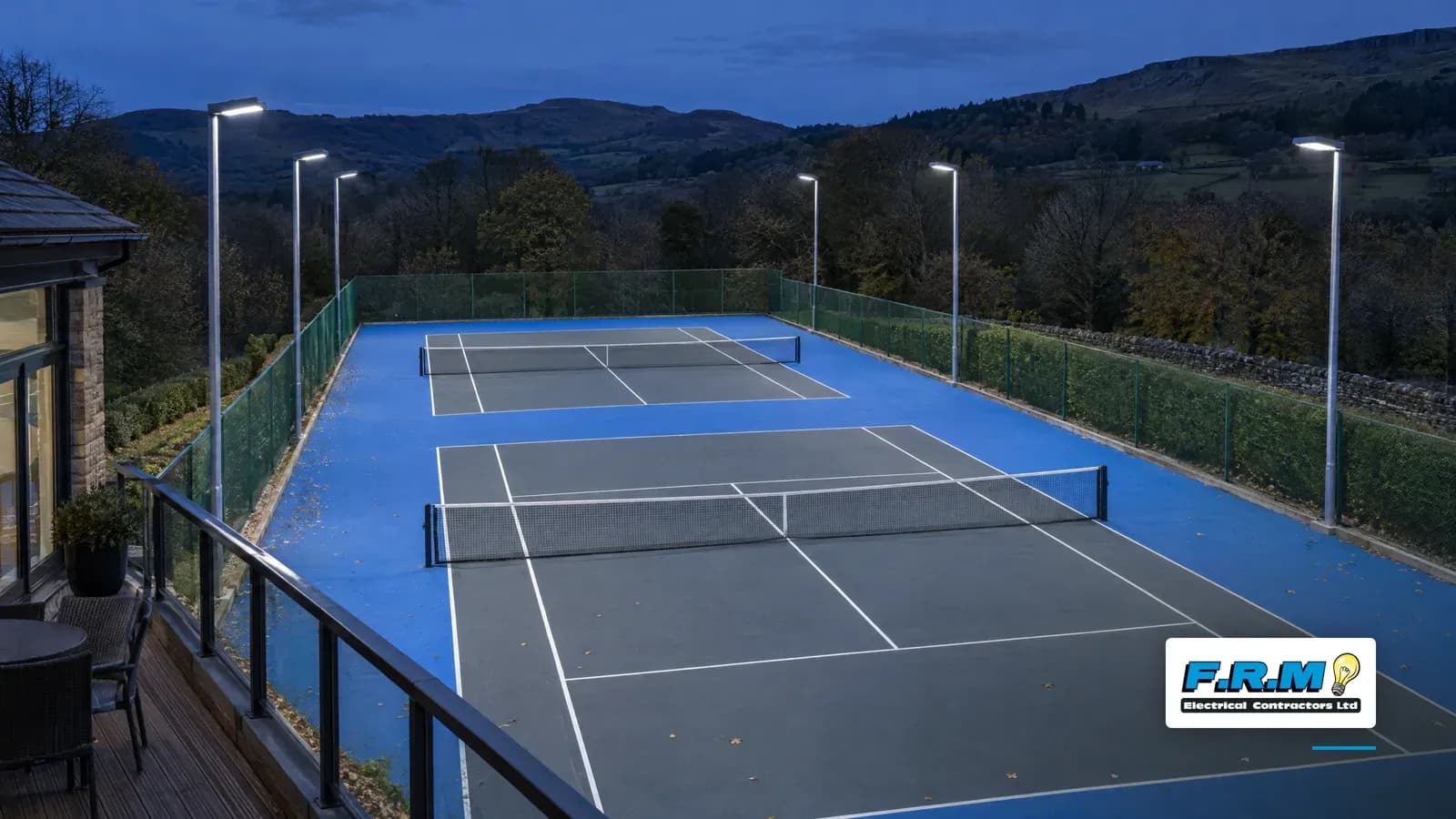
What floodlights do for a club
The LTA's own figures make the case. Venues with floodlights have, on average, 50% more members than those without, and keep them for longer. An outdoor court with no lights offers about 2,500 playable hours a year once bad weather is allowed for, and a floodlit one about 3,500. Between November and April, lighting adds roughly 35% more playing time, which is what lets a club run coaching all year and take pay and play bookings on dark evenings.
Three ways to lay out tennis court floodlighting
The LTA's floodlighting guidance describes three generic layouts. Which one fits depends on how many courts sit in the block, how much room there is between them and how close the neighbours are.
Side lit. Columns run down both sides of the court, typically 10 metres high and usually at least three to a side. Glare is reduced, on the court and beyond it, and spill is well controlled. The drawback is that it only works neatly for courts lit and switched in pairs. Switching each court separately means columns between the courts, and that takes at least 6.1 metres of clear space at the baseline.
Corner lit. Columns stand at the corners, typically 10 metres, with 8 the minimum. It uses the fewest columns, the LTA rates it as cost effective, and it suits blocks of three or more courts switched separately where space is tight. The price is more potential for glare, so the aiming has to be chosen with care. The columns generally stand outside the fence, and their height is more noticeable in daylight.
Corner and side lit. A mix of the two on the lowest columns, typically 6.7 or 8 metres, carrying lower-wattage fittings. It controls glare, sky glow and spill well, but it needs more columns and more fittings, and can cost more to put in.
Whichever layout is used, the guidance wants each fitting mounted with its glass tilted less than 35 degrees from the playing surface, with louvres or shields added if needed where houses are near.
Switching the lights: by court and by booking
Decide how the lights will be operated before they are designed, because it changes the wiring. The LTA lists three approaches: direct switching from the clubhouse, tokens, and control through the booking system.
The third means nobody has to be on site. With the LTA's SmartAccess Premium gate system, a court booked through ClubSpark, the LTA's booking platform, for a dark hour has its lights switched on and off at the right times, and the player gets a PIN for the gate. LED fittings reach full output at once, so they can come on as the player walks in. Older lamps that need a warm-up can be set to start ahead of the booking and stay on between back-to-back sessions.
Two details catch clubs out. The cheaper, battery-powered version of the gate system cannot control floodlights at all, and the LTA advises against it at lit venues. The Premium version needs a power supply taken to the gate, which is far easier to duct in while the trenches for the columns are open than to add a year later.
Power, ducts and the electrical installation
The first question on any scheme is whether the existing supply can carry it. As a rule of thumb from the LTA, a club lighting two or three courts may manage on an ordinary single-phase supply, while more than three floodlit courts usually means the network operator will want three-phase. We work out the site's existing load before the design is fixed, since a new supply brings its own application and waiting time.
Cables reach the columns through ducts, with draw pits so they can be pulled in now and replaced one day without digging. The guidance is to keep both outside the court block where possible, and at the least outside the playing area, which normally means the strips between courts. At an established club, that makes the trench route one of the first things to settle, because nobody wants a court surface cut.
From there it is an outdoor electrical installation, and we build and certify it as one. Cable is sized for the length of the run, because voltage falls over distance and the furthest column still has to get what it needs. Each circuit can be isolated on its own, metal columns are earthed, and the equipment is rated for weather all year round. The wiring regulations give outdoor lighting a section to itself. When the work is finished you receive an Electrical Installation Certificate, and from then on the installation needs periodic inspection and testing like any other, which we also carry out.
Converting metal halide floodlights to LED
For a club that already has lights, the LTA sets out a process, and it starts with paperwork rather than fittings.
Find the original planning consent and its documents. Check that the existing lights comply with it and that every condition was discharged.
If the columns are staying and they are more than 20 years old, have them structurally checked for strength.
If there are houses within about 30 metres, get a specialist design that models the light reaching those properties and shows the new scheme meets the existing conditions.
Where it does, apply to the council for a non-material amendment, which is a minor change to the consent you already hold. If that is refused, a fresh planning application is needed.
Only then tender the work, making sure the new fittings can be mounted on any columns being kept.
The gains are the ones the LTA lists for LED in general: a lower power requirement, no lamps to replace, and the ability to dim. What schemes cost, and the light levels the LTA requires, are covered in our guide to sports floodlighting costs and lux levels.
The order to do a new scheme in
The LTA is clear that every new scheme needs planning consent, and its recommended sequence is built around getting that at the first attempt.
Have a specialist produce a lighting design that meets the performance standard and is realistic for the site.
Review the site: where the supply sits in relation to the courts, and what the lights could affect, such as neighbouring homes, trees and wildlife.
Show the outline design to the neighbours and the planning authority before applying, and adjust it to answer objections where you can.
Obtain quotes from at least three contractors, checking that each is NICEIC or ECA registered, or similarly approved.
Finalise the design with the contractor you appoint and submit the application, with plan and elevation drawings alongside it.
Satisfy any conditions attached to the permission that have to be met before work begins.
Install, test the finished scheme, and collect the operation and maintenance manuals.
FRM is an NICEIC Approved Contractor, with CHAS and JIB accreditation as well, and we are comfortable being one of your three quotes. We can be the designer at the first step, a tenderer at the fourth, or both: we provide the lighting design and the technical detail a planning application relies on, then install, commission and certify the scheme. To price one, we need a plan of the courts, details of the electricity supply and, for a conversion, the original planning consent.
Our Bamford scheme, and where we work
We designed and installed the LED floodlighting at Bamford Tennis Club in the Peak District. Photographs are in the Bamford case study. Tennis is one part of our wider sports venue lighting service, which also takes in pitches, driving ranges and multi-use games areas. We travel nationally for floodlighting, and nearer home we cover Sheffield, Rotherham and the rest of South Yorkshire.