
The light levels governing bodies set for tennis, padel, netball and 3G football, the latest published cost benchmarks, and the site factors that decide what a scheme costs to build and run.
Sports floodlighting has to hit a set light level, not simply look bright. The LTA's minimum for a floodlit tennis court is 400 lux across the main playing area, and The FA wants at least 200 lux on a full-size 3G pitch. What it costs depends mostly on columns, the electricity supply and planning conditions.
What lux levels does sports floodlighting need?
Lux measures how much light lands on the playing surface. On its own it is only half the specification. The other half is uniformity, the lowest reading on the surface divided by the average, which tells you whether the light is spread evenly or pooled under the columns with dim patches in between. A court that averages the right figure but has a dark corner fails the standard.
For tennis, the LTA sets its figures for two zones: the principal playing area inside the lines, and the total playing area including the run-off around the court.
LTA recommended: 500 lux on the principal playing area at 0.7 uniformity, and 400 lux on the total playing area at 0.6.
LTA minimum: 400 lux and 0.7 uniformity inside the lines, with 300 lux and 0.6 across the whole area.
For 3G football turf pitches, The FA's guidance asks for a maintained average of more than 200 lux at 0.6 uniformity for full-size matches, and more than 120 lux at the same uniformity for training and cross-pitch play. Its 2025-26 stadium accreditation criteria hold new installations from Grade 2 downwards to the same 200 lux minimum.
Behind both sits BS EN 12193, the European sports lighting standard, which sorts facilities into three classes: Class I for top-level competition with spectators at a distance, Class II for mid-level club and regional competition, and Class III for training, school sport and recreational play. The FA's 200 lux figure corresponds to Class II.
Why the maintained figure matters more than day one
Every one of those numbers is a maintained value. Industry guidance on tennis floodlighting defines maintained illuminance as the level still being achieved once the fittings have degraded to the end of their performance life. Light output drops as luminaires age and the glass collects dirt, so a scheme designed to give exactly 400 lux when new will fall below standard as it ages.
The design therefore starts higher and allows for that decline, and a good tender makes the allowance visible. When comparing lighting designs, ask what maintenance factor each one assumes. Two schemes that promise the same lux can be very different installations underneath.
Padel courts and multi-use games areas
Padel has figures of its own. The LTA's 2025 padel court construction guidance sets 300 lux at 0.5 uniformity for regional competition and recreational play, and 500 lux at 0.7 for national and international competition. Whether the fittings sit on extended fence posts or on standalone columns outside the enclosure, they must leave at least 6 metres of clear height above the court. The same guidance says every padel court needs planning consent, and that light and noise surveys are likely where a home sits within 50 metres.
A multi-use games area is harder, because each sport marked on it brings its own standard. England Netball's design guidance for outdoor community courts asks for 200 lux maintained at 0.7 uniformity, a more even spread than The FA asks for, and the LTA's tennis minimum is double netball's light level. A surface lined for all three is best designed around the most demanding of them rather than the one played most often.
What does sports floodlighting cost?
The most reliable public benchmark is Sport England's facility cost guidance, which is compiled with the Building Cost Information Service. Its figures for the third quarter of 2026 cover complete facilities, fenced and with sports lighting, and the LTA publishes comparable figures for padel from projects delivered in 2025:
Multi-use games area, macadam, 36.6m by 21.35m: £195,000.
Two tennis courts, macadam: £270,000.
Four tennis courts, macadam: £475,000.
Six tennis courts, macadam: £620,000.
One padel court with lights, plus ring beam, base, ducting and drainage (LTA): £71,000.
Four padel courts on the same basis (LTA): £268,000.
Sport England's totals include the surface, fencing, a notional allowance for external works and fees at 6%, but exclude VAT, regional price variation, poor ground conditions, difficult access and long service connections. The LTA's padel figures exclude VAT and fees. Neither source separates out the lighting, and nobody can honestly give a single figure for that, because the floodlighting on two identical courts can cost very different amounts depending on the site. What decides it is covered in the next section, and any real price starts with a survey and a lighting design.
The factors that move the price
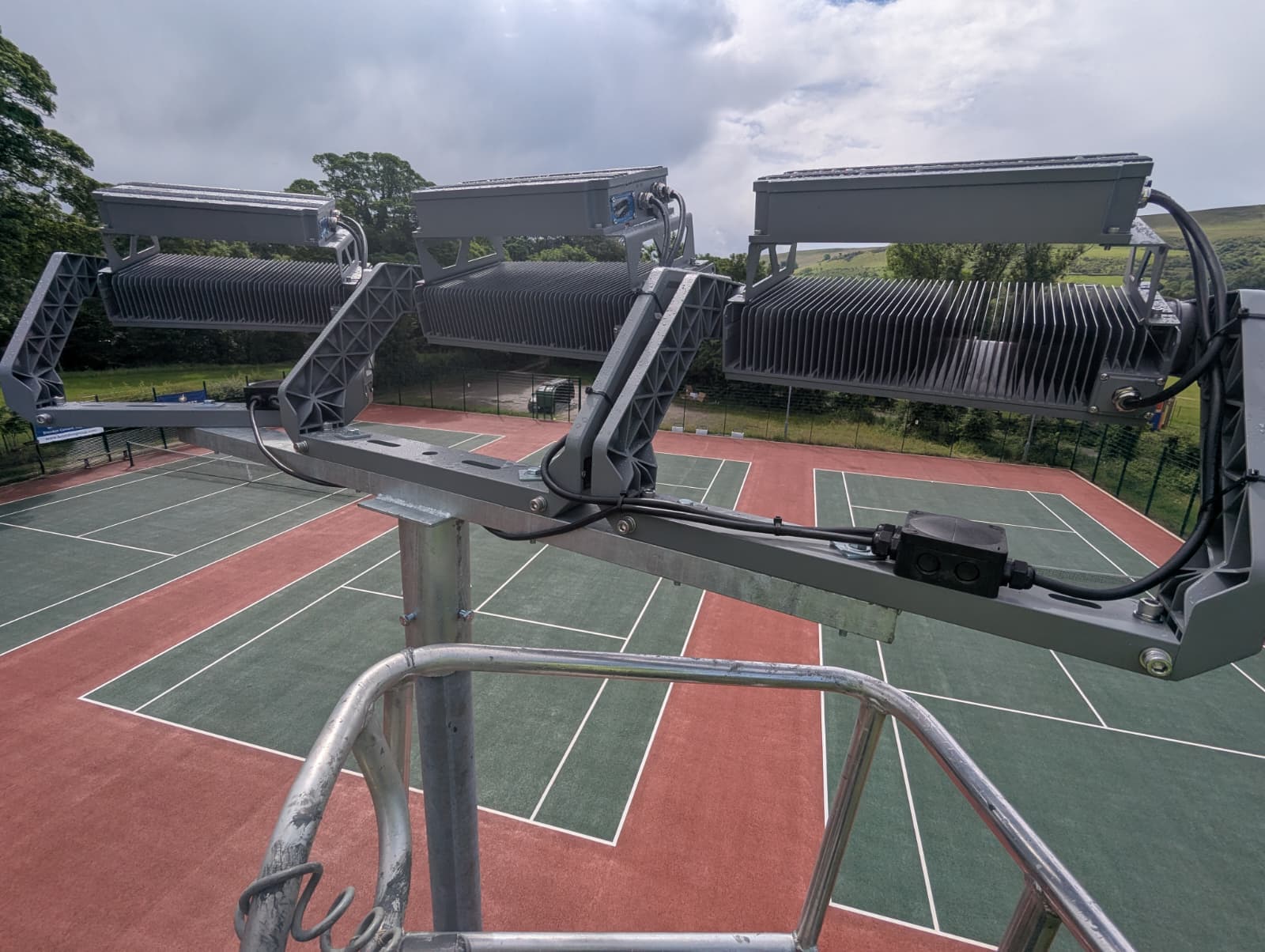
Column height and number. Tennis guidance puts floodlight columns between roughly 6 and 10 metres. Taller columns need fewer positions and give good uniformity, but planning authorities in residential areas are less willing to accept them, and dropping the height usually means more columns and more luminaires to reach the same standard.
Foundations and ground. Every column needs a foundation designed for its height and wind loading, and poor or made ground makes those dearer.
Getting power to the courts. Whether the existing supply has spare capacity, and how far cable has to run from the intake to the playing area in ducting, can be a large share of the cost on a spread-out site.
Controls. Switching each court or pitch section separately, and putting the lights on timers, add cost at installation and save it every night afterwards.
Reusing what is there. Keeping sound existing columns can save a great deal on an upgrade, provided they are strong enough for the new heads.
The consent route. Lighting reports and whatever conditions come with the permission all feed into the budget, which is the subject of the next section.
Planning permission, curfews and the neighbours
New floodlight columns normally need planning permission. The application should carry the lighting design itself: column positions and heights, predicted light levels on the playing surface, and modelled light spill and glare beyond the site boundary. Where the site borders hedgerows, trees or water, the authority may also ask for a lighting strategy that protects bats, following the ILP's guidance note on bats and artificial lighting.
The usual yardstick for that spill is the Institution of Lighting Professionals' guidance on obtrusive light, which sorts locations into environmental zones and caps the light falling on the windows of nearby properties:
E1, dark rural areas such as national parks: 2 lux before curfew, under 0.1 lux after.
E2, sparsely inhabited rural areas and villages: 5 lux before curfew, 1 lux after.
E3, suburban areas and small town centres: 10 lux before curfew, 2 lux after.
E4, busy town and city centres: 25 lux before curfew, 5 lux after.
The zone is agreed with the planning authority, and where a site sits on the boundary of two the stricter one applies. A curfew condition limiting the hours the lights can be used is one of the most common conditions attached to a permission, so settle the playing hours the club actually needs before the application goes in. The FA's guidance allows a minimum of 8 to 13 weeks for the planning stage.
Upgrading old floodlights to LED
The FA recommends LED for any 3G pitch with long hours of use. It is dearer to buy than metal halide, but The FA's view is that the energy and maintenance savings pay back the difference. LED also comes on instantly without a warm-up, can be dimmed, and its integrated louvres and cowls keep more of the light on the playing surface.
Two checks come first on any upgrade. LED heads are heavier than the metal halide fittings they replace, so The FA advises a structural report on columns being kept, and possibly a strength test. And if the original planning permission carried conditions about the lighting, ask the planning authority whether new heads need consent before ordering them.
Working out what the lights cost to run
Running cost is simple arithmetic once the design is done. A lighting design states the total electrical load of the scheme in kilowatts, and every kilowatt switched on for an hour uses one unit of electricity.
As a worked example with illustrative figures rather than a quote: a scheme drawing 10kW, used for three hours a night, five nights a week across a 26-week winter season, uses 3,900 units. At a unit price of 25p that is £975 for the season. Put your own load, hours and tariff into the same sum.
On top of electricity, budget for keeping the installation up to standard: cleaning the fittings, checking the aiming has not been knocked out, and periodic electrical inspection of what is an outdoor installation exposed to the weather all year.
Floodlighting schemes we have designed and installed
Our own sports lighting work includes a full LED floodlighting design and installation for Bamford Tennis Club, built to competition lux levels, and floodlighting across the driving range at Cheshunt Golf Centre, lit brightly and evenly while staying kind to its neighbours. Photographs of both are on our projects page.
We take on floodlighting schemes right across the UK, and closer to home across South Yorkshire, from Sheffield to Barnsley. How we survey, design, install and commission a scheme is set out on our sports venue lighting page.
Frequently asked questions
Can we run floodlights off the clubhouse supply?
Sometimes, but only after adding up what the clubhouse already draws at its busiest and comparing that with what the supply can deliver. A small LED scheme may fit within the spare capacity. Larger schemes, or clubs already near their limit, can need a bigger or three-phase supply from the network operator, and that application and its lead time belong at the very start of the project, not after the columns are ordered.
Do all our courts have to be lit at once?
No. The LTA applies its standard court by court, measured on each court when it is lit on its own, so a well-designed block can light one court at a time and still meet the numbers. That also means a scheme cannot borrow light from the court next door to pass.
How do we know the lights meet the standard once they are installed?
By measuring them. At commissioning, readings are taken with a calibrated meter on a grid across the playing surface and compared with the design, both for the average and for uniformity. Because the design allows for future decline, readings on a new installation should come in above the maintained target. Keep that survey, since a governing body may ask to see it.
Is there funding for sports floodlighting?
There can be. The Football Foundation, Sport England and the sports' governing bodies all run funding programmes for facilities, but what is open, and what it will pay towards, changes from year to year. Check the current rules before fixing a budget, because funders usually have their own technical requirements, and a scheme designed without them in mind may not qualify.