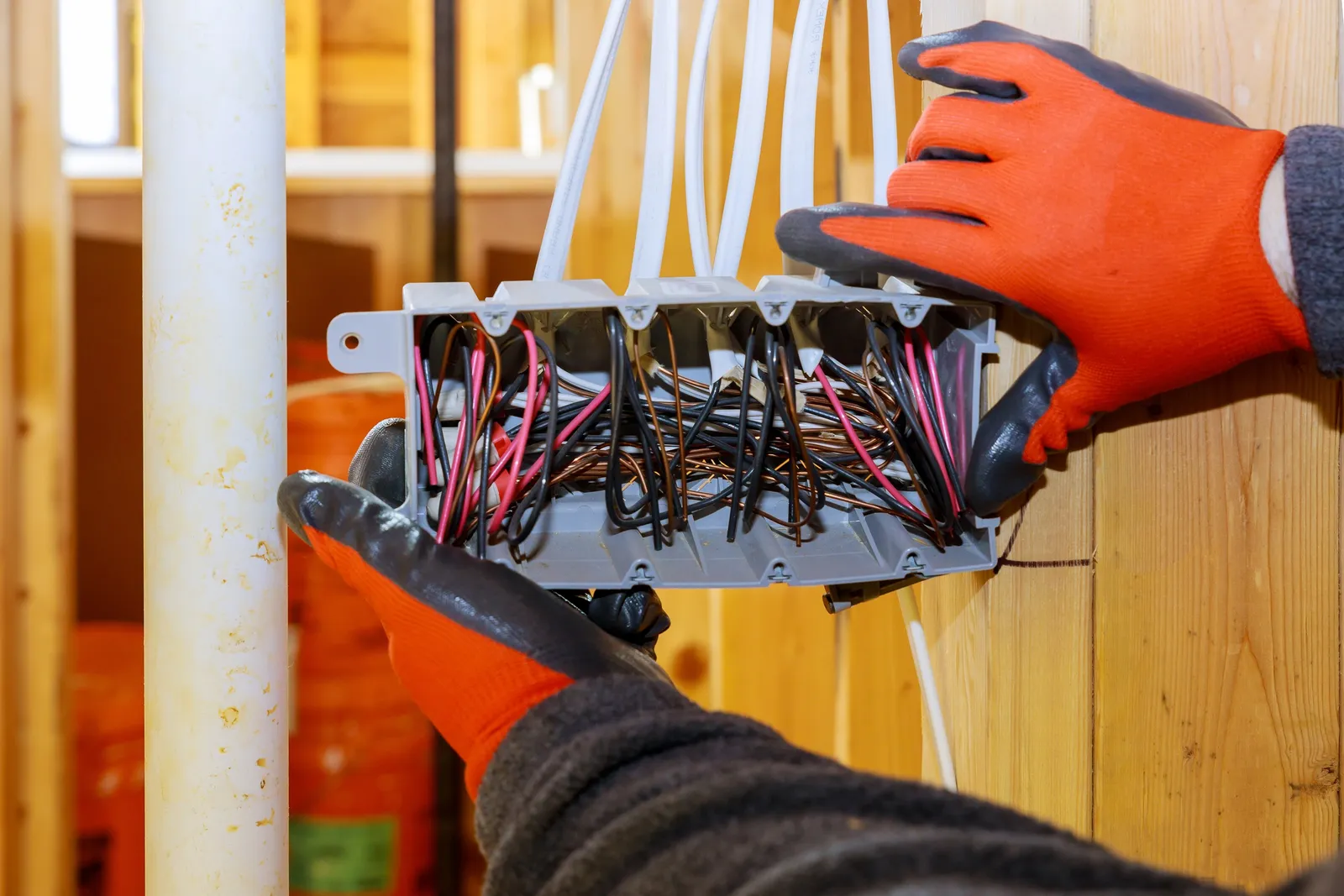

A heat pump needs its own circuit, the right protection on the consumer unit and room within your main fuse. Here is what an electrician checks before install day, and why.
The main heat pump electrical requirements are simple to list: its own circuit from the consumer unit, a spare way with the right type of residual current protection, and a protected cable and isolator at the outdoor unit. The whole house, heat pump included, must also stay within what your main fuse can carry, and the network operator must be told.
Heat pump quotes tend to concentrate on the heating side: the unit, the cylinder, the radiators. The electrical side gets less attention until the week of the install, which is exactly when a full consumer unit or a tight main fuse is most expensive to discover. This guide covers what your electrics need to do, what the network operator needs to know, and the order to do things in.
What are the heat pump electrical requirements?
For an air source heat pump in an ordinary house, the electrical work breaks down into a short list.
Its own circuit. That circuit is sized from the manufacturer's electrical data: the rated current, the maximum current and the protective device the maker specifies. Smaller domestic units often sit on a 16 or 20 amp circuit, larger ones on 32 amps or more.
A spare way on the board, with the right protection. The new circuit needs a free space in the consumer unit and residual current protection of the type the manufacturer states. That detail matters more than it used to: inverter-driven equipment can produce leakage currents that the oldest style of residual current device (RCD), known as Type AC, cannot properly detect, and current regulations no longer treat Type AC as suitable for general use.
A circuit for the hot water cylinder. Many systems include an immersion heater in the cylinder as a backup and for periodic high-temperature cycles, and that needs its own supply too.
A safe route outside. The cable to the outdoor unit has to be protected along its whole length, through the wall and across to the unit, and there should be an isolator beside the unit so it can be switched off safely for servicing.
Controls wiring. Thermostats, sensors and valves are wired back to the heat pump's controller, usually through a wiring centre near the cylinder.
Certification and notification. A new circuit is notifiable work under the building regulations, so you should receive an Electrical Installation Certificate and a building regulations compliance certificate. The network operator has to be told about the heat pump as well, as explained below.
How much electricity does a heat pump actually draw?
Less than people expect at any one moment, and more than people expect over a winter. The Energy Saving Trust puts a typical air source heat pump at around three units of heat for every unit of electricity it uses. So a unit delivering 8 kilowatts of heat draws roughly 3 kilowatts on an average day, and more in a cold snap when it works least efficiently, which is still well under an electric shower.
The difference is duration. A shower runs for ten minutes. A heat pump in a cold spell can run for most of the day and evening, including the hours when everything else in the house is switched on: the oven, the hob, the kettle, the washing machine. It is the overlap, not the heat pump on its own, that decides whether the supply is comfortable or tight.
Will my main fuse and supply cope?
Every house has a main fuse where the supply enters, usually rated at 60, 80 or 100 amps, and the question is what the house could reasonably draw at its busiest once the heat pump is added. Electricians call that the maximum demand. It is not a simple sum of every appliance, because not everything runs at once, but the big loads are worth knowing in round numbers at 230 volts:
An electric shower of 8.5 to 10.5 kilowatts: roughly 37 to 46 amps while it runs.
A 7 kilowatt car charger: about 32 amps for hours at a time.
An immersion heater of 3 kilowatts: about 13 amps.
A large induction hob: up to around 32 amps with every zone on full.
An 8 kilowatt heat pump: roughly 12 to 16 amps, depending on how efficiently it is running; the maker's data sheet gives the maximum running current to design around.
Those figures show why a car charger is a bigger strain on the supply than the heat pump. Where both are planned, a charger with load management, which eases off the car when the house is busy, usually solves it without a supply upgrade; our Barnsley charger installation page explains how that works and how to read your main fuse rating.
The network operator for South Yorkshire, Northern Powergrid, has to be told about a new heat pump whatever the outcome. Under the industry process published by MCS, the Microgeneration Certification Scheme, where the property's maximum demand including the heat pump stays at or below 60 amps, the installer can connect it and notify the operator within 28 days. Between 60 and 100 amps, an application has to be made before installation. Separately, some older streets have looped services, where one supply cable feeds two neighbouring houses; if yours is one, the operator will need to look at it before extra load goes on, and that can add time.
Does a heat pump mean a new consumer unit?
Not necessarily. A modern board with a spare way, the right type of RCD protection and surge protection may only need the new circuits adding. The upgrade becomes worthwhile, or unavoidable, when:
There is no spare way, and no sensible room to add a small second board beside the first.
The existing RCDs are the wrong type for the heat pump.
The board is an older type with rewireable fuses, or has no RCD protection at all.
You are adding several things at once, such as a heat pump, a charger and a battery, and a single well-planned board is simpler than three separate additions.
If the board is on its way out anyway, doing it before or alongside the heat pump avoids two sets of disruption. Our page on fuse board and consumer unit replacement covers what a new board involves and why one sometimes trips on faults the old board ignored, and our guide to the signs a consumer unit needs upgrading will help you judge where yours stands.
Where should the outdoor unit go?
Where the outdoor unit goes is usually decided by the heating design, the noise rules and the space outside, but the electrical route deserves a say before anything is fixed to a wall. A unit on the far side of the house from the consumer unit means a longer, heavier cable, more holes and more making good. It is worth looking at both sides of the house before the position is settled.
Planning rules loosened in England on 29 May 2025. The old requirement to keep an air source heat pump at least a metre from the boundary was removed, the permitted size of the unit went up to 1.5 cubic metres, and detached houses can now have two units under permitted development. Noise limits still apply, and listed buildings and conservation areas carry extra restrictions, so your installer should confirm the position qualifies before anything is ordered.
Who does the electrical work, and in what order?
Heat pumps are normally supplied and fitted by an installer certified under MCS, which the Boiler Upgrade Scheme grant depends on. Some have their own electricians and some subcontract the electrical side. Either way, the electrical work should be surveyed early, not on install day, and the sequence that avoids delays is simple:
Survey the supply, the main fuse, the earthing arrangement and the consumer unit when the heat pump is first being quoted.
Sort any board upgrade or supply issue before the heat pump is delivered.
Run the circuits and the outdoor supply ready for the heating engineers.
Commission, test, certify and notify once everything is connected.
Timing matters because of the grant. Under the Boiler Upgrade Scheme, currently £7,500 towards an air source or ground source heat pump in England and Wales, with a temporary extra £1,500 until 31 March 2027 for homes off the gas grid that are heated by oil or liquefied petroleum gas (LPG), the installer applies on your behalf and the grant comes off your invoice. Once Ofgem issues the voucher, an air source heat pump has to be installed and commissioned within three months, or six for ground source. An electrical problem found late can eat into that window.
If your consumer unit or supply needs attention before a heat pump goes in, that is work we carry out from Wath upon Dearne out through Rotherham and Barnsley.
Frequently asked questions
Do I need a three-phase supply for a heat pump?
No. Domestic air source heat pumps run on an ordinary single-phase supply. Three-phase is only a consideration for very large properties or commercial systems, and very few UK homes have it.
What changes electrically when the gas boiler comes out?
The boiler's own fused supply is freed up and can often be reused for controls. If the gas supply is removed entirely, the bonding cable that connects the gas pipe to the earthing system should be checked and the paperwork updated, so ask for the installation to be looked over once the heating work is finished.
Can solar panels run the heat pump?
Partly, and less than you might hope. Panels produce most in summer, when a heat pump is mainly making hot water, and least in the dark winter months when it works hardest. Solar still cuts the cost of running one, and a battery can shift some daytime generation into the evening, but the heat pump should be planned on the assumption that winter heating comes from the grid.
What happens to the heating in a power cut?
It stops, exactly as a modern gas boiler does, because both need electricity for their pumps and controls. A well-insulated house holds its heat for some hours, and the system normally restarts on its own when the power returns.
The bottom line
A heat pump on its own rarely overloads a house. The real questions are whether the board has a free way and suitable protection for it, and whether the heat pump, a car charger, an electric shower and the rest of the house fit comfortably within the main fuse. Get those answered at the quoting stage, and the electrical side becomes the easy part of the job instead of the thing that holds up the install.