
What fixed wire testing covers, board by board
The work starts at the intake and follows the installation outwards, one distribution board at a time. At each board there are two parts to it.
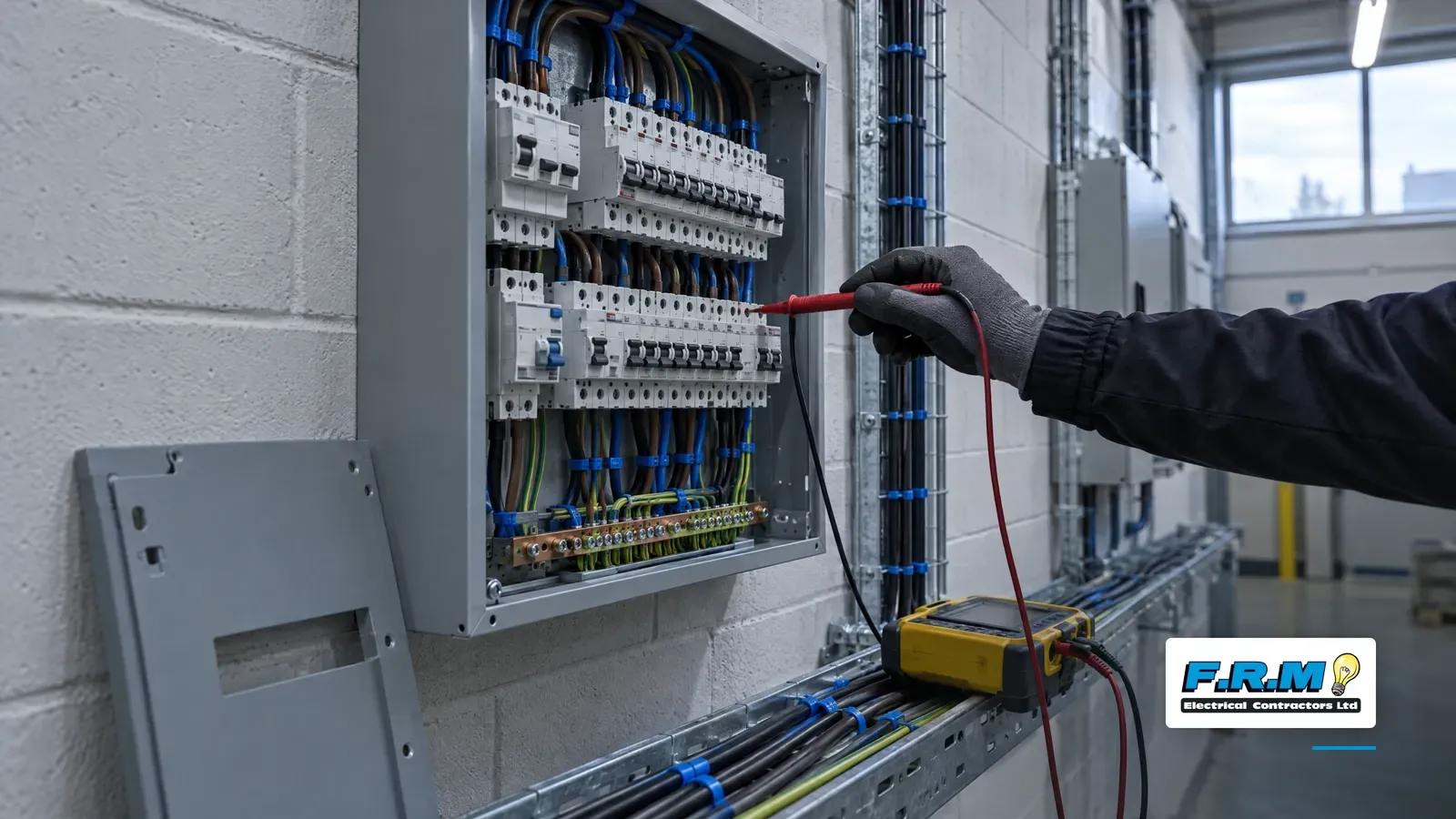
Inspection. With the cover off, we look for what instruments cannot see: signs of overheating, damaged or undersized cables, missing barriers, poor terminations, the wrong type of protective device for the circuit, absent or broken earthing and bonding, and labelling that no longer matches what the board feeds.
Testing. With the circuit isolated, we prove the protective conductors are continuous, check ring circuits are complete, measure insulation resistance and prove polarity. With it live again, we measure earth fault loop impedance and prospective fault current, and time the RCDs to see that they trip as fast as they should. Each reading goes against its circuit in the schedule of test results.
The result is an Electrical Installation Condition Report, the EICR, which is the document insurers, landlords and enforcing authorities mean when they ask for a fixed wire test certificate.
Where the fixed wiring stops
Scope is where quotes differ most, so it is worth settling this line before anyone prices the work.
Inside the scope: the intake, switchgear, distribution boards, sub-mains, final circuits, sockets, fixed lighting, isolators, earthing and bonding. Electric vehicle chargers, solar and battery systems are part of the fixed installation too, with one part that needs separate testing, explained in the questions below.
At the boundary: fixed machinery and plant. We inspect and test the supply up to the machine's isolator and its connection. The wiring inside the machine belongs to the machine and its maintenance regime.
Outside it: anything on a plug, which is the business of PAT testing, and the emergency lighting and fire alarm systems themselves. The circuits feeding those systems are tested, but the systems are checked to their own standards. We can carry out emergency lighting and PAT testing on the same visit if asked, and our page on fire alarm and CCTV systems deals with detection.
In a multi-let building there is a second line, between the landlord's installation and yours. A tenant's report normally starts at the tenant's own board, though your lease decides exactly where the line falls. The intake, the risers and the common parts are the landlord's to test, and it is reasonable to ask for a copy of their report.
Keeping a working site working
Dead testing means isolating circuits, and on a trading site that has to be planned, not sprung on people. Before the visit we agree with you which boards can go off, when, and for how long, and which circuits need notice given to staff or tenants. Boards are taken one at a time where the installation allows. The main switchgear needs one full shutdown, which is planned with you for the quietest time.
Where daytime isolation is not possible, we work evenings or weekends. On sites that are never quiet, the inspection can be split into a rolling programme that covers a different area each year, with each visit reporting on the area it covered. Our facilities manager's guide to commercial EICRs covers how to prepare IT and other sensitive equipment for the day, and how often each type of premises should be inspected.
What we need to price it
A price for fixed wire testing is only as good as the information behind it. Send us what you have of the following and the quote will state what it covers.
The number of distribution boards, and roughly how many circuits each carries.
Whether the supply is single-phase or three-phase.
The previous report, if there is one, and any certificates for work done since.
The hours we can have access, and any areas that need an escort or a permit.
Whether a sample is acceptable to you, your insurer and your landlord, or every circuit must be tested.
If none of that exists, we can visit to look at the boards before quoting. A price written without seeing them is a guess.
What you are left with
You receive the full report: the extent of what was inspected and any limitations, the schedule of readings, and every observation tied to its board and circuit and photographed, so that whoever prices the repair can find it. A notice fixed at the origin of the installation gives the date the next inspection is recommended. Where circuit charts were missing or wrong, ask whether they can be corrected during the visit, while the circuits have just been traced.
Amendment 4 and your next report
Amendment 4 to BS 7671, the wiring regulations, was published in April 2026 and applies in full from 15 October 2026. It changes how a report reaches its verdict. Only observations coded C1, danger present, or C2, potentially dangerous, now make a report unsatisfactory. C3, improvement recommended, and FI, further investigation, are listed separately and no longer affect the overall result. Under the previous edition an FI did. The IET's guidance adds that an inspection is not a fault-finding exercise and that an FI should rarely be needed.
None of this turns an older installation into a failure overnight. One built to an earlier edition is not unsafe for that reason alone, so be wary of any quote for remedial work justified only by the regulations having changed.
Putting the findings right
Anything immediately dangerous is raised with you on the day and made safe with your agreement before we leave. Everything else is quoted separately afterwards, letting you see what is urgent and what can be planned into a budget. We carry out the remedial work ourselves and certify it separately, and the report stays as it was issued. If you would sooner have a different contractor do the repairs, the report is written so that they can.
Fixed wire testing across South Yorkshire
FRM is NICEIC approved, and is CHAS and JIB accredited. Testing is part of our wider test and inspection service, and it comes from the same firm that has delivered commercial and industrial installation work for JLL, Amazon, Vital Energi and Barnsley Council. We cover Rotherham, Sheffield, Barnsley, Doncaster and the towns between them from Wath upon Dearne. Call us or use the quote form with the details above.