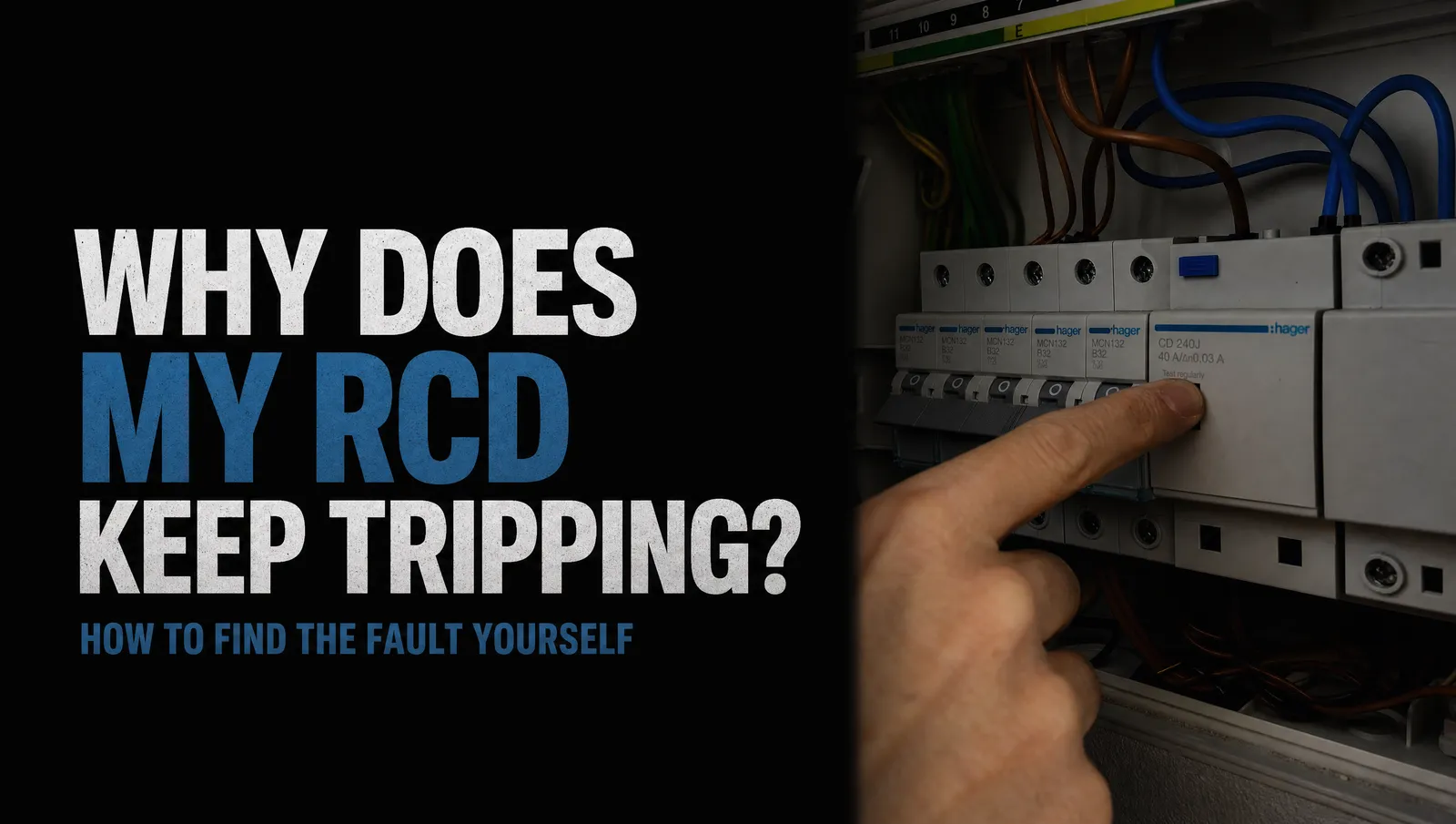

An RCD that keeps tripping is detecting current leaking to earth. Here is how to narrow it down to the circuit and the appliance yourself, and when to hand it over.
An RCD keeps tripping because it is detecting electricity leaking to earth somewhere on your installation. Usually it is one faulty appliance or a circuit that has taken in water, and you can trace it yourself in about half an hour by switching everything off, resetting, and adding things back one at a time.
The frustrating part is that a tripping board rarely announces what is wrong. It just goes off, often at the least convenient moment, and then behaves perfectly for two days.
This guide walks through the same process an electrician follows, in the order they follow it, so you can either fix it yourself or ring someone already knowing which circuit to point at.
First, work out which switch actually tripped
Before anything else, open the board and look at what is sitting in the off position. Three different things can drop out, and they mean three different things.
One small breaker on its own. That is an MCB or an RCBO protecting a single circuit, and the problem is limited to that circuit: the kitchen sockets, the upstairs lights, the shower.
A wider switch that takes several circuits with it. That is an RCD. It sits over a group of circuits, so the fault could be on any one of them, which is why half the house going dark tells you less than you would like.
The big main switch. Everything off, including things that have their own breaker. That is uncommon and it is not one to work through yourself.
The rest of this guide deals mainly with the middle case, because that is the one people find hardest to pin down.
What an RCD is actually reacting to
An RCD compares the current flowing out to your appliances with the current coming back. In a healthy circuit the two match.
If some of it goes missing, it is going somewhere it should not: through damaged insulation, through damp, or through a person. The device cuts the supply in a fraction of a second.
So an RCD tripping is not a fault with the RCD. It is the one part of your board doing exactly the job it was fitted for. That distinction matters, because the instinct when something trips repeatedly is to assume the device has become oversensitive, and that is almost never what is happening.
The half-split test: finding the fault in half an hour
This is the method, and it works because the fault has to be on one circuit and, most of the time, in one thing plugged into it. You are not guessing, you are narrowing.
Unplug everything on the affected circuits. Not switched off at the wall, physically out of the socket. Include the things people forget: the freezer in the garage, the phone chargers, the extension lead behind the telly, the pond pump. Switch off the immersion heater and the electric shower at their pull cord or isolator.
Turn off every breaker on the board, then reset the RCD so it stays up with nothing connected to it.
Turn the circuits back on one at a time, waiting a few seconds after each one. When the RCD drops, the circuit you just switched on is the guilty one. Write it down.
Now work inside that circuit. With it switched on and holding, plug appliances back in one at a time, oldest and biggest first. Anything with a heating element or a motor is a better suspect than a lamp.
When it trips, you have your appliance. Leave it unplugged and see whether the board holds for a full day and night before you decide you are finished.
Two outcomes are worth planning for. If a circuit drops the RCD with absolutely nothing plugged into it, the fault is in the fixed wiring or in something wired in permanently: an immersion element, a shower, an extractor fan, an outside light, a boiler. That is the point where testing takes over from switching things on and off.
And if nothing trips at all during the whole exercise, you have an intermittent fault rather than a permanent one. Go to the next section, because the pattern is now your best evidence.
What the timing is telling you
When a fault will not show itself on demand, when it happens is the clue. These patterns come up again and again.
Only when it rains, or the morning after. Look outside. Garden lighting, an outside socket, a cable to a shed or a garage, a hot tub supply. Water finds its way into a joint or a badly fitted enclosure and leaks to earth until things dry out.
Garage and shed supplies are the usual offenders, particularly the ones added by a previous owner to a standard nobody would sign off today.
The same time every evening or in the middle of the night. Something is running on a timer or a thermostat while you are not watching it. Immersion heaters, storage heaters and a freezer running its defrost cycle are the classic three.
Only when the shower or the hot water is on. That points hard at a heating element. Elements fail by breaking down internally, so they leak only while energised and can test perfectly well cold.
Only in cold snaps. Condensation inside an outdoor enclosure or an unheated garage, doing the same job as rain.
Instantly, every time you reset it, with every circuit off. Stop there. That is a fault between neutral and earth on the board side of things, and it needs a tester rather than a process of elimination.
What it means when your RCD keeps tripping but nothing is broken
There is a version of this problem where every appliance works, no circuit is faulty, and the board still drops out every few days. It is worth understanding, because it changes what the fix is.
Every appliance leaks a tiny amount of current to earth in normal use. It is measured in milliamps and it is entirely normal on its own. The trouble is that it adds up.
A standard RCD is rated at 30mA, and under the product standard it is allowed to operate anywhere between 15mA and 30mA, so a board carrying 14mA of perfectly ordinary standing leakage can sit there for years and then start tripping the week you plug in one more thing.
The wiring regulations account for this by recommending that the leakage sitting behind one device stays under 30 per cent of its rating, which is 9mA on a 30mA RCD.
Fill a modern house with LED drivers, chargers, computers, an induction hob and an inverter appliance or two, put half of them behind a single device, and that figure is easy to pass without anything at all being wrong.
Where that is the diagnosis, adding more circuits or another appliance will only make it worse, and the answer is to split the load so each circuit sits behind its own protection instead of sharing. Our page on fuse board replacement and consumer unit upgrades covers how boards are arranged and what happens to older installations when protection is added.
One related point if your board is genuinely old. Devices of the original Type AC design cannot see the kind of leakage produced by modern electronics, and since 2022 they have not been suitable for general use in a domestic installation. That is a safety shortcoming rather than a tripping problem, but it tends to come to light during the same visit.
When it is the MCB, not the RCD
If the switch that keeps dropping is a single small breaker, you are dealing with a different fault entirely and the half-split test above is the wrong tool.
A breaker trips for two reasons. Either the circuit is being asked to carry more current than it is rated for, which is an overload, or there is a direct short between live and neutral, which trips it instantly and hard.
Overloads have an obvious signature: the kitchen goes off when the kettle, the toaster and the dishwasher all run together, and it never happens otherwise. Spreading that load across sockets on different circuits is a reasonable first move.
A lamp failing is the other common one. Filaments and LED drivers can dump a brief fault as they die, taking the lighting circuit out at that exact moment. One event, a blown bulb to show for it, and no pattern afterwards means there is nothing to chase.
What you must never do is fit a larger breaker to stop a circuit tripping. The rating is matched to the cable buried in your walls, not to the appliances you would like to run, and increasing it removes the protection that stops that cable overheating.
When to stop resetting and get it looked at
Resetting a tripped device once, or twice while you work through the steps above, is a normal thing to do. Doing it repeatedly over weeks is different: it means running an installation with a known earth fault in it and relying on the RCD to keep catching something nobody has found.
Stop and call a qualified electrician if any of these apply:
Any smell of hot plastic, scorch marks, buzzing, or a board that is warm to the touch.
It will not reset at all, or will not stay up with every circuit switched off.
The main switch is what keeps tripping.
Anyone has felt a tingle or a shock from an appliance, a tap or a metal fitting.
It trips again within minutes of every reset.
The first item on that list is the urgent one, and it is worth treating as such rather than waiting for a convenient appointment. If it is out of hours and the house is without power, that is what an emergency electrician is for.
One practical thing while you are waiting. If a freezer sits on the circuit you have isolated, move the contents or run it temporarily from a socket on a healthy circuit using a suitable extension lead. Coming home to a defrosted freezer is a miserable way to compound a small electrical fault.
How an electrician finds what you cannot
There is a hard limit to what switching things on and off can tell you, and it is worth knowing where it sits so you can judge when to hand the job over.
The first tool is an insulation resistance test. With the circuit dead and disconnected, a test voltage is applied between conductors to measure how well the insulation is still holding. It finds cable that has broken down inside a wall, an element that has failed internally, and damp that no visual inspection would show.
The second is a leakage clamp used on a live board, which reads the standing current on each circuit in milliamps. That is the only way to diagnose the accumulation case described above, because it puts a number on every circuit instead of a guess and identifies the two or three contributing most.
Between them they turn an intermittent nuisance into a measured fault with a location. Where a tripping call turns out to be a wider condition problem rather than one bad appliance, a full electrical test and inspection puts the whole installation on paper, circuit by circuit.
FRM Electrical is NICEIC-approved and family run, working out of Wath upon Dearne. If your board is dropping out and you would rather have it measured than guessed at, we cover Wath upon Dearne and the Dearne Valley along with the rest of the towns listed here.
Frequently asked questions
How long does it take an electrician to trace a tripping fault?
A fault that is present all the time is usually located within an hour or two, because it shows up on a test the moment the right circuit is disconnected.
An intermittent one is a different job: it can need a return visit, or a leakage monitor left connected for several days to catch the fault while it is actually happening. Most electricians price fault-finding by time rather than as a fixed job for exactly this reason, so it is fair to ask how the charging works before anyone starts.
Can I test the RCD myself?
Yes. The button marked T or Test on the front of the device creates a small artificial fault, and pressing it should switch the power off immediately.
Doing that every three months is sensible, and if the device does not trip when you press it, that is a genuine fault to report. It confirms the mechanism works, but it tells you nothing about the leakage sitting on your circuits.
Does a tripping RCD mean I need a new fuse board?
Not by itself. A device tripping on a modern board is far more likely to be reporting a real fault on a circuit than to be failing. Age is what changes that answer, and the evidence to look for is set out separately in the seven signs a consumer unit is due for upgrading.
Why did it start tripping right after we had building work done?
Because something was disturbed. A screw or a nail through a buried cable, a fitting put back with a trapped conductor, water into a chased wall that has not dried out yet, or a new circuit added to a board that was already close to its limit. Tell the electrician what work was done and roughly where, as it usually saves a good deal of searching.
Is it dangerous to leave a circuit switched off until someone can come?
No, and it is the sensible thing to do once you have identified which circuit is at fault. An isolated circuit is a safe circuit. Leave the breaker off, leave a note on the board so nobody helpfully switches it back on, and keep the rest of the house running normally.
Could a storm or a power cut have caused it?
It can. A surge on the incoming supply, or the sudden return of power after a cut, can push a marginal component over the edge, most often in a boiler, a shower or outdoor equipment. If everything resets and behaves normally afterwards, treat it as a one-off. If it starts tripping regularly from that day on, something took damage and it is worth finding.
The bottom line
A tripping RCD is a warning that is working, not a device that has become fussy. Half an hour with the steps above will usually give you either a faulty appliance you can throw out or the name of the circuit that needs a tester on it.
Either result is worth far more to whoever comes out than a phone call that starts with the board just keeps going off.